
A house fire can affect a Denver property in several ways at once. Flames and heat may damage materials near the source, while smoke and soot can move into rooms that never burned. Water used by firefighters or sprinkler systems can create another path of damage through floors, walls, ceilings, insulation, and belongings.
Once the emergency is under control, homeowners usually have a new set of questions. What can be restored? Where did the smoke travel? How will wet materials be dried? What information does the insurance company need? How long will the process take?
Rytech Restoration of Greater Denver helps homeowners, commercial property owners, property managers, insurance professionals, and referral partners navigate these questions. The local team provides 24/7 emergency response, IICRC-certified technicians, property damage inspections, advanced moisture detection, contents cleaning, odor removal, water damage restoration, mold remediation, and commercial restoration services. Rytech also works directly with insurance professionals and can bill insurance carriers directly when applicable.
Here are answers to common questions Denver property owners have after fire, smoke, soot, and firefighting water damage.
What Are Common Causes of Fire Damage in Denver Homes?
Cooking, heating equipment, electrical problems, fireplaces, smoking materials, candles, grills, and other heat or ignition sources can lead to residential fires. Kitchens and garages can contain several ignition sources close to combustible materials, while fireplaces and heating equipment deserve extra attention during Colorado's colder months.
Property layout can influence how a relatively small fire affects the rest of the home. Denver-area properties range from older homes with traditional construction to newer houses, townhomes, condominiums, apartments, and commercial buildings. Open floor plans may allow smoke to spread broadly, while stairways, wall cavities, attics, and mechanical systems create other pathways.
Colorado's climate adds another dimension. Wildfire smoke may also affect homes and businesses without flames ever reaching the structure. The IICRC S760 wildfire guidance addresses the evaluation and restoration of structures, systems, contents, and personal property affected by wildfire smoke, including soot, char, ash, and odor.
This distinction matters because a structure fire and wildfire smoke exposure create different conditions. Professional judgment should account for the source, building conditions, direct observations, project objectives, and the experience and training of the people performing the evaluation.
“After 10 years working with homes and building materials, I’ve learned that what you can see after property damage is only part of what needs to be evaluated. Greater Denver has everything from older wood-framed homes and masonry construction to newer drywall assemblies, finished basements, complex flooring systems, and modern HVAC layouts. Fires, frozen-pipe water losses, and other local property emergencies can affect those materials in very different ways, so our job is to inspect the property carefully and determine what can be restored before unnecessary materials are removed.”
Dan Powell, Owner, Rytech Restoration of Greater Denver
Dan is a Denver native with 10 years of experience in the home improvement field. He holds IICRC certifications in Water Damage Restoration Technician, Applied Structural Drying, and Applied Microbial Remediation Technician, along with Lead Renovator RRP certification.
What Should I Do Immediately After a House Fire?
Personal safety comes first. Leave the building, account for everyone who was inside, and follow instructions from firefighters and other emergency personnel.
Once emergency officials release the property, contact your homeowners insurance provider and a qualified restoration company. Early documentation creates a clearer record of conditions before cleanup begins. Photographs, videos, inventories, and professional inspection findings can help homeowners, restoration professionals, agents, and adjusters understand the loss.
Avoid treating soot like ordinary household dust. Fire residues vary according to what burned, and moving soot-covered belongings through unaffected areas can spread contamination. Cleaning an affected surface without first considering its material and the residue can also make restoration more difficult.
A professional assessment creates an organized path forward. The restoration team can determine which areas require cleaning, which materials need drying, whether contents should be moved, and which damaged materials are beyond restoration.
Rytech Restoration of Greater Denver maintains 24/7 emergency service. Its local customer promise states that after speaking with a live Rytech specialist, an IICRC-certified technician can be at the property in four hours or less.
How Is Fire Damage Assessed and Inspected?
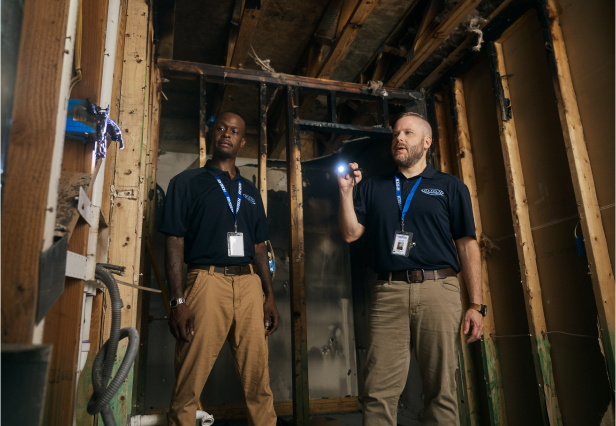
A fire damage inspection looks beyond the visibly burned area. Professionals evaluate heat and fire impact along with smoke distribution, soot, odors, building materials, contents, possible HVAC involvement, and water introduced during firefighting.
Building materials deserve close attention. Professional fire restoration guidance identifies wood, steel, concrete, and masonry as common structural materials and directs restorers to recognize visible evidence of heat and fire impact that may have compromised structural components and require additional expertise.
Smoke movement can expand the inspection area considerably. Structural fire guidance recognizes that a building's recirculating HVAC system can provide a pathway from the fire source to other portions of the building. When preliminary findings indicate possible HVAC impact, further assessment can determine whether specialized HVAC restoration should be considered.
Firefighting water creates a different pathway. ANSI/IICRC S500 directs restorers to evaluate and document water migration using appropriate moisture-detection equipment. The standard identifies tools including moisture sensors, thermo-hygrometers, invasive and non-invasive moisture meters, infrared thermometers, and thermal imaging cameras. Thermal imaging can reveal surface-temperature patterns associated with possible moisture, but those findings should be verified with a moisture meter.
Imagine a kitchen fire in a Denver home with a finished basement. Flames may remain upstairs, smoke may enter adjoining rooms, and firefighting water can migrate through flooring or into the level below. A thorough inspection follows each damage pathway instead of assuming everything stops at the edge of the visible burn area.
How Do I Start an Insurance Claim for Fire Damage?

Contact your insurance company or agent and report the fire. Have your policy information available and provide the basic facts surrounding the loss. Your insurance professional can then explain how the policy's coverage, deductible, limits, and other provisions apply.
Documentation gives everyone involved a clearer picture. Photographs, videos, inventories, receipts, and records of affected belongings can help document the property and contents. Professional restoration documentation can add inspection findings, photographs, measurements, moisture readings, and records of completed mitigation work.
Most property owners rarely handle a major fire claim, so the process can feel unfamiliar. Insurance agents, adjusters, carriers, and restoration professionals work with property losses regularly, and each has a different role in moving the claim and restoration forward.
Rytech Restoration of Greater Denver works directly with insurance professionals. When an insurer assigns a claim to Rytech, the company states that it contacts the policyholder, sends a certified technician to assess and document the damage, and obtains authorization before beginning restoration work.
For insurance professionals and property managers, that documentation and communication provide visibility into what technicians found and what work is being performed.
What Is the Difference Between Professional Fire Restoration and DIY Cleanup?
A small soot stain may look like something that can be wiped away with a household cleaner. The material underneath that soot can change the answer.
Painted drywall, unfinished wood, finished cabinetry, metal, stone, tile, flooring, fabrics, and upholstery respond differently to residues and cleaning methods. What burned also influences the characteristics of the residue.
Professional restoration begins by evaluating both the affected material and the fire residue. Industry fire restoration guidance supports a stepwise process that can progress from lighter surface cleaning to heavier methods as conditions require. The approach starts with less aggressive techniques before moving toward more aggressive ones.
That supports a restoration-first mindset. Materials that can be successfully cleaned, dried, and restored should be evaluated before unnecessary demolition takes place. When materials are damaged beyond restoration, they can be identified and removed as part of the mitigation scope.
Professional restoration also looks beyond cleaning the visible soot. Smoke distribution, odor, contents, HVAC systems, firefighting water, and hidden moisture may all need attention.
What Does Fire Damage Restoration Usually Cost?
The cost of restoring fire damage depends on what actually happened inside the property. A limited cooking fire that leaves soot in one area creates a very different scope from a multi-room fire involving smoke, contents, water, and heat-damaged materials.
Current 2026 national consumer-market data from Angi places professional fire damage restoration between approximately $3,083 and $52,031. Its current estimates place cooking-fire restoration around $12,000 to $20,000, electrical-fire restoration around $12,000 to $23,000, and combustible-metal fire restoration around $16,000 to $25,000. These are broad national consumer estimates rather than Greater Denver project quotes.
Square footage is only one part of the cost. Fire type, soot conditions, materials, contents, firefighting water, odor, accessibility, labor, specialty evaluations, and the amount of material that can be restored all influence the project scope.
Restoration decisions can make a meaningful difference. When affected materials can be successfully cleaned and dried instead of unnecessarily removed, the project can involve less demolition, disruption, and costly material removal.
Insurance compensation depends on the individual policy and covered loss. Your insurance professional can explain how the deductible, limits, dwelling coverage, personal property provisions, and other policy terms apply.
How Are Smoke and Soot Removed After a Fire?
Professional smoke restoration starts by determining where residues traveled. Technicians then evaluate the surfaces, materials, and contents within those areas.
Different materials require different cleaning approaches. Painted walls, wood, metal, tile, stone, flooring, upholstery, and other materials do not all respond to soot in the same way.
Industry fire restoration guidance supports progressing from less aggressive to more aggressive restoration methods based on the effectiveness of the work and the conditions found. The work plan can change when hidden conditions are discovered or a material responds differently than expected.
HVAC involvement may also need consideration. In a structural fire, recirculating mechanical systems can provide a route for smoke residues to reach areas beyond the original source. Assessment findings help determine whether additional HVAC evaluation is appropriate.
Rytech Restoration of Greater Denver provides professional property damage restoration services in Denver with IICRC-certified local technicians, advanced inspection technology, contents services, odor removal, and related restoration capabilities.
How Are Smoke Odors Removed?
Smoke odor can linger even after the most visible soot has been cleaned. That smell can point toward affected materials or spaces that still need attention.
Successful deodorization begins with the source. Cleaning residues from affected surfaces and contents addresses the material producing the odor rather than simply covering the smell.
Depending on project conditions, restoration may include detailed surface cleaning, ventilation, air filtration, contents treatment, and specialized deodorization procedures. Porous materials may require a different approach from hard surfaces.
Professional fire restoration guidance recognizes visual and odor assessment as useful parts of evaluating restoration results. In wildfire restoration, for example, post-restoration evaluation can include visual inspection, in-field evaluation, and smoke odor detection.
If your Denver home looks clean but still smells smoky, that lingering odor provides a reason to look deeper.
What Happens if Firefighting Water or Sprinklers Soak the Property?
Water used to stop a fire can create a second restoration challenge. Fire hoses and sprinkler systems may wet drywall, insulation, flooring, cabinets, wood framing, ceilings, furniture, and other materials.
Professional water restoration follows the water rather than relying only on what can be seen. ANSI/IICRC S500 specifically notes that water can flow under walls or come from above, so adjoining rooms should be inspected even when water is not visible on the surface.
Once affected materials are identified, drying goals provide measurable targets. S500 defines a drying goal as a target moisture level or moisture content established by a qualified restorer. Those goals should be documented for specific materials and are intended to return structures, systems, or contents to an acceptable condition while inhibiting microbial growth.
Denver's seasonal conditions can influence that process. S500 directs restorers to consider prevailing or seasonal weather, regional history, building assemblies, project complexities, and expected conditions after drying when establishing drying goals.
That means a fire restoration project can also become a water restoration project, with both conditions managed as parts of the same property loss.
What Happens if Mold Develops After Fire Sprinkler Use?
Wet building materials can support microbial growth when moisture conditions persist. A fire loss can therefore develop a mold component when sprinkler discharge or firefighting water remains inside affected materials.
The first step is understanding where the water traveled. Moisture may be hidden beneath flooring, behind walls, inside cabinets, or within other assemblies even after exposed surfaces begin to dry.
When mold growth is discovered or suspected during a water restoration project, ANSI/IICRC S500 directs restorers to the current ANSI/IICRC S520 Standard for Professional Mold Remediation.
Professional mold remediation focuses on controlling the affected work area, removing mold-affected materials as appropriate, cleaning, and reducing harmful mold spores in the indoor environment. Moisture conditions also need to be addressed because drying and remediation are closely connected.
Rytech Restoration of Greater Denver's owner, Dan Powell, holds IICRC certifications in both Applied Structural Drying and Applied Microbial Remediation, giving the local operation experience with the connection between moisture and microbial conditions.
What Happens When Fire Affects Structural Materials?
Heat can affect framing, roof assemblies, floors, walls, and other structural components. The amount of impact depends on the material, location, duration of heat exposure, and intensity of the fire.
Professional fire restoration guidance identifies wood, steel, concrete, and masonry as common structural building materials. Restorers should recognize evidence that fire or heat may have compromised structural components and identify situations where additional expertise is needed.
That distinction defines Rytech's role clearly. The restoration team evaluates affected materials, restores materials that can be successfully saved, and removes materials that are beyond restoration. When a structural engineer, electrician, HVAC professional, roofing contractor, or another specialty professional needs to evaluate a particular system, that expertise can become part of the broader recovery process.
A blackened framing member does not tell the whole story by appearance alone. Evaluation establishes the condition and helps the appropriate professionals determine what comes next.
Can Personal Belongings Be Saved After Fire Damage?
Many belongings can potentially be restored. Exposure to smoke or soot does not automatically make every item in the room a total loss.
Furniture, clothing, décor, household goods, and other contents can be evaluated based on their material, heat exposure, residue, odor, moisture, value, and ability to respond to cleaning. Some belongings can be cleaned within the property, while others may benefit from removal to another location for contents processing.
Fire restoration standards recognize contents and personal property as their own part of the restoration process. The evaluation considers what can reasonably be restored and what cannot.
When non-salvageable personal property is part of an insurance claim, documentation and communication become particularly useful. IICRC S760 notes that when an insurance carrier compensates the owner for non-salvageable property, authorization may be required before that property is disposed of.
For homeowners and insurance professionals alike, an organized contents record can make a large loss much easier to follow.
What Health and Safety Conditions Can Remain After a Fire?
Once the flames are extinguished, the property may still contain several conditions requiring evaluation. Smoke and soot residues may remain on surfaces, building materials can be affected by heat, firefighting water may be hidden inside assemblies, and electrical or structural components may require specialized assessment.
The visible burn area does not necessarily define the affected area. Smoke may move upward, through connected rooms, or into mechanical systems. Water may travel downward or underneath walls and flooring.
Commercial buildings add another layer. Offices, retail properties, multifamily communities, warehouses, restaurants, and other Denver-area facilities may have larger HVAC systems, more contents, multiple occupants, and several stakeholders involved in recovery.
A professional inspection connects those pieces. Instead of asking only, “Where did the fire burn?”, ask “Where did the fire, heat, smoke, soot, odor, and water travel?”
That question produces a much more useful restoration plan.
How Long Does Fire Damage Restoration Usually Take?
A limited smoke-cleaning project can move relatively quickly, while a major fire involving multiple rooms, contents, firefighting water, structural evaluation, and specialty professionals can take considerably longer.
The restoration timeline depends on affected square footage, soot conditions, drying requirements, contents processing, accessibility, specialty evaluations, material conditions, and coordination among the parties involved. Hidden conditions can also change the scope after work begins.
Industry fire guidance recognizes this reality. IICRC S760 describes restoration as a dynamic activity where hidden conditions and the effectiveness of restoration methods can cause the original scope to change. The guidance calls for a Restoration Work Plan after inspection, with anticipated outcomes communicated to materially interested parties.
For a commercial property owner or manager, that communication can be just as valuable as the restoration itself. Employees, tenants, insurance professionals, vendors, and building owners may all need accurate information about the work underway.
Rytech Greater Denver emphasizes clear communication and a streamlined restoration process designed to reduce disruption and help customers get back to normal faster.
How Do I Choose a Fire Damage Restoration Company in Denver?
Start with qualifications. Look for relevant IICRC certifications, proper licensing and insurance, experience working with property losses, professional inspection methods, and an organized approach to documentation.
Then ask how the company makes decisions about affected materials. Does the team inspect before removing materials? Will technicians use moisture-detection equipment when firefighting water is involved? How will contents be evaluated? What information will be documented for you and your insurance professionals?
Local experience adds value because Denver properties vary widely in age, construction, mechanical systems, and building materials.
Rytech Restoration of Greater Denver combines local experience with Rytech's more than 30 years in the restoration industry. The Greater Denver location promotes local Colorado experts, IICRC-certified technicians, 24-hour response, licensed, bonded and insured service, industry-standard estimates, insurance coordination, and professional damage assessment.
Dan Powell also brings 10 years of home improvement experience and IICRC certifications in Water Damage Restoration, Applied Structural Drying, and Applied Microbial Remediation. His focus for the Greater Denver operation centers on customer satisfaction and the health and safety of the local community.
For property owners, managers, agents, adjusters, carriers, and referral partners, that combination provides a local team capable of explaining both what technicians are doing and why they are doing it.
How Can Denver Homeowners Reduce Future Fire Damage?
Fire prevention starts with everyday habits. Stay attentive while cooking, keep combustible materials away from heating equipment and fireplaces, maintain electrical systems, and make sure everyone in the household understands what to do when an alarm sounds.
Denver's climate makes heating equipment and fireplaces a practical part of seasonal planning. Furnaces, portable heaters, fireplaces, chimneys, and other heating equipment should be maintained according to manufacturer and professional recommendations.
Working smoke alarms provide another layer of preparation. Test alarms regularly, maintain them according to manufacturer guidance, and make sure the home's alarm placement provides appropriate coverage for sleeping and living areas.
Colorado property owners should also consider wildfire exposure. Homes do not need to experience direct flames to be affected by wildfire smoke, ash, char, and odor. The IICRC S760 guidance specifically addresses how wildfire combustion particles can enter structures and affect surfaces, contents, and HVAC systems.
Finally, review your homeowners insurance coverage periodically and maintain a current home inventory. Photos or video of rooms, major belongings, and valuable possessions can provide useful documentation if a future loss occurs.
Get Inspected to Stay Protected After Fire or Smoke Damage
Once the immediate emergency has passed, knowing the true extent of the damage gives everyone involved a clearer path forward.
Rytech Restoration of Greater Denver serves homes and businesses throughout Denver, Lakewood, Arvada, Golden, Wheat Ridge, Westminster, Broomfield, Thornton, Centennial, Englewood, Evergreen, Highlands Ranch, Littleton, Morrison, and surrounding communities across Jefferson, Denver, Broomfield, Adams, Arapahoe, and Douglas counties.
If your home, rental property, commercial facility, or insured property has been affected by fire, smoke, soot, odor, firefighting water, or related moisture damage, call Rytech Restoration of Greater Denver at (303) 515-7512. Live specialists are available 24/7 to answer questions and help connect you with an IICRC-certified local technician.
GET INSPECTED TO STAY PROTECTED.
FAQs: Answering Your Pressing Fire Damage Repair Questions
At Rytech Greater Denver, we know that dealing with fire damage can feel overwhelming. To help make things easier, we’ve put together a list of frequently asked questions to guide you through what to expect. From how our restoration process works to what happens during each step, these FAQs are designed to give you clarity, confidence, and peace of mind when you choose us to restore your home or business.


